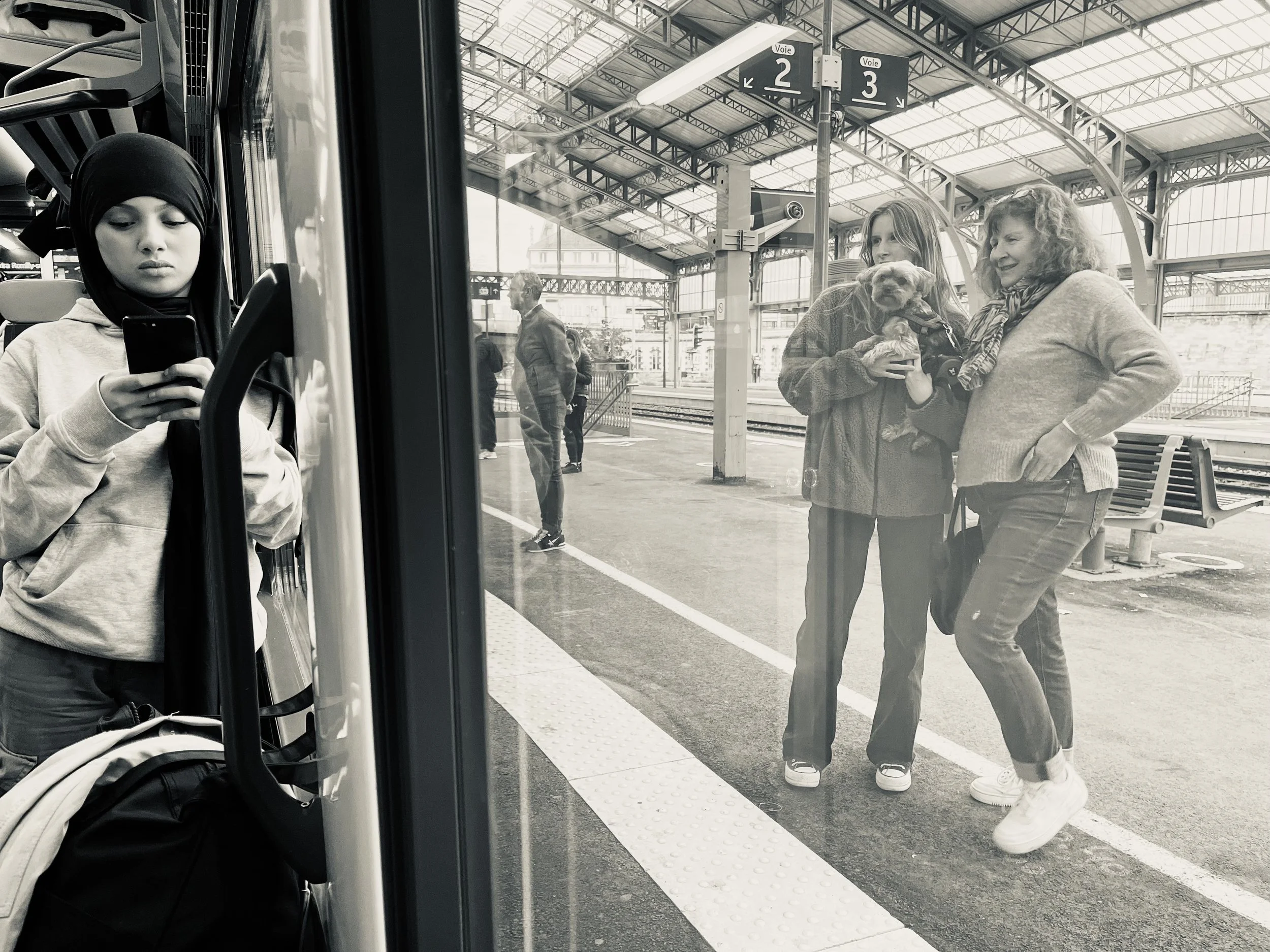
Familiar Strangers was born in a little shop at 16 rue Arthur Groussier, near the Canal St Martin in Paris’ 10th arrondisement. This is where I run workshops (in English + French), photograph, write, collect stories, translate, and research (Belonging, Nationality, Musicology, Cultural Anthropology). You might see me through the window. Writing, drinking coffee, looking at you. Come in, say hello, tell me your stories.
For those who don’t know, a *familiar stranger is a stranger who is nonetheless recognised by another from regularly sharing a common physical space such as a street or metro stop, but with whom one does not interact. My goal is to change that in a place where strangers become familiar.
(*Stanley Milgram, a social psychologist, introduced in 1972 the “familiar stranger” concept: people regularly seen but never interacting, producing recognition without relationship or social connection in everyday urban life. Milgram is best known for his obedience experiments (1961–63), where participants were instructed to administer shocks to others—revealing how ordinary people obey authority even against their conscience. He also studied the “small-world phenomenon” (the “six degrees of separation” idea) and explored urban behavior, social networks, and how people navigate modern city life.)
Familiar Strangers est né dans une petite boutique au 16 rue Arthur Groussier, près du Canal St Martin dans le 10e arrondissement de Paris. C'est ici que nous organisons des ateliers (en français + anglais), photographions, écrivons, collectons des histoires, traduisons et faisons des recherches (Appartenance, Nationalité, Musicologie, Anthropologie sociale). Vous pourriez me voir par la fenêtre. Elle j’écris, boit du café, vous regarde. Entrez, dites bonjour, racontez-moi vos histoires.
Pour ceux qui ne le savent pas, un *étranger familier est un étranger qui est néanmoins reconnu par une autre personne pour avoir partagé régulièrement un espace physique commun tel qu'une rue ou un arrêt de métro, mais avec lequel on n'interagit pas. Mon objectif est de changer cela.
(*Stanley Milgram, psychologue social, introduit en 1972 le concept d’« étranger familier » : des individus vus régulièrement sans interaction, générant une reconnaissance sans relation ni lien social dans la vie urbaine quotidienne. Milgram est surtout connu pour ses expériences sur l’obéissance (1961–1963), montrant jusqu’où des individus ordinaires obéissent à l’autorité, même contre leur conscience. Il a aussi étudié le phénomène du petit monde (« six degrés de séparation ») et les comportements urbains, notamment les réseaux sociaux et la vie en ville.)
